The History of Talavera Pottery
A blue bird on a Puebla jar can evoke both Chinese porcelain and a bird familiar to Mesoamerican communities. The history of Mexican Talavera is full of such encounters. Potters in Puebla and Tlaxcala worked with local clay and knowledge while adapting techniques and designs that had traveled across oceans.
What makes this pottery Talavera?
In its historical Mexican sense, Talavera is a tradition of tin-glazed earthenware centered in Puebla and neighboring Tlaxcala. Tin oxide makes the glaze opaque, giving the painter a light surface on which blue outlines and colored motifs remain legible. This family of ceramics is also called majolica, or maiolica, in museum catalogues. The word describes a kind of pottery, while Talavera poblana gives that pottery a regional history. The Metropolitan Museum of Art’s essay on Talavera de Puebla introduces the technique and its name.
The same glazed surface suited very different objects. A bowl could carry a band of flowers around its rim. A tile could repeat a small pattern across a wall. A rounded jar invited a painter to carry a branch or a row of birds around the body. That versatility helps explain why the tradition lives in museum collections, working shops, and the streets of Puebla.
Puebla, Tlaxcala, and the Spanish connection
Talavera de la Reina, in central Spain, lends its name to the Mexican ware. Spanish potters brought techniques for making wheel-thrown, tin-glazed pottery to New Spain in the sixteenth century. Mexico City was already producing tin-glazed earthenware by the middle of that century. Puebla emerged as a leading center in the years that followed, and by the mid-seventeenth century it had an organized potters’ guild. Those developments help trace the growth of the trade. The Met’s record for an eighteenth-century Puebla jar and the Philadelphia Museum of Art’s exhibition on colonial Mexican pottery describe this early production.
Indigenous potters brought extensive knowledge of clay and decoration to the region’s ceramic work. The Museo Regional de Puebla preserves examples of pre-Hispanic polychrome pottery from Cholula, evidence of how long potters there had been working with complex painted surfaces. The joint nomination submitted by Mexico and Spain to UNESCO also identifies Indigenous workers’ expertise with clay as a factor in the growth of the colonial industry. These sources establish a long regional history of ceramic skill. Tracing any particular technique or motif to a specific community requires evidence from the object or another historical record. Museo Regional de Puebla · Mexico and Spain’s UNESCO nomination dossier (PDF)
Puebla’s workshops benefited from nearby clay and a position on the trade routes that crossed New Spain. The history also extends beyond the city. San Pablo del Monte in Tlaxcala is one of the pottery communities described in the joint nomination. Its place in the living tradition matters because the name talavera poblana can make the story sound as though it belongs to one city alone.
How the colors and patterns changed
Chinese porcelain entered New Spain through Acapulco on the Manila galleons. Much of the cargo traveled overland to Veracruz by way of Puebla, and imported pieces gave potters examples of unfamiliar vessel shapes and designs. The blue-and-white palette is a lasting sign of this trade. A chocolate jar made in Puebla around 1700 shows stylized blue birds whose outlines recall the Chinese phoenix. The Met interprets them as quetzals and leaves open how deliberately the painter made that association. The Met’s Puebla jar record · The Met’s chocolate jar
Other palettes tell their own stories. The Met’s entry for a covered bowl from about 1825 describes the arrival of new tones and ornamental styles in the nineteenth century, including rose, mauve, and pale blue. A later bowl in the Museo Amparo collection has freehand flowers in green, yellow, blue, and orange, organized into panels around the outside. Seeing these pieces together helps explain why blue and white alone cannot date a piece or establish its maker. The Met’s covered bowl · Museo Amparo’s polychrome bowl
On architecture, the unit of design could be a single azulejo, or glazed tile. At the Casa de los Muñecos in Puebla, tiled panels form human figures across the façade. A tile in Museo Amparo’s collection shows another approach: its corner details join with neighboring tiles to form a larger geometric design. Both examples reward a close look at how small painted parts build a scene or pattern at the scale of a wall. BUAP University Museum’s history of the Casa de los Muñecos (in Spanish) · Museo Amparo’s polychrome tile
The knowledge behind the glaze
Long before the decorator paints a flower, someone has prepared the clay, shaped the object, and waited for it to dry. Firing hardens the clay, then the painter works over the pale glaze before the piece returns to the kiln. Each stage affects the ones that follow. A broad bowl and a small tile give different clues about shaping and drying, even if the two pieces came from the same workshop. Follow the sequence in the guide to how Talavera pottery is made.
Some makers carry out several stages, while others specialize. A painter learns how a brush loads and releases pigment. The person tending the kiln learns how materials behave under heat. The official heritage accounts describe skills transmitted within workshops and families. An electric wheel can change how the potter powers the wheel while leaving the decisions about shape and thickness in the potter’s hands. INAH’s account of the artisanal tradition
A published oral history from Puebla’s La Concepción workshop gives a view of how this learning happened. The painter Consuelo Aurelia Guevara Cordera recalled that her mother, Virginia Cordera Salazar, took ideas from embroidery and knitting patterns in magazines and taught her daughters to paint. Consuelo also remembered outlining tiles for a project in Cholula while others filled in the yellow and blue. The work passed from hand to hand, just as the skills passed between generations. INAH’s published interview with Consuelo Guevara Cordera
What UNESCO recognized
In 2019, UNESCO added the artisanal making processes in Puebla and Tlaxcala in Mexico and in Talavera de la Reina and El Puente del Arzobispo in Spain to the Representative List of the Intangible Cultural Heritage of Humanity. The joint inscription recognizes the skills, tools, and workshop knowledge that people pass on. A surviving jar records a technique at one moment. A working workshop allows a new generation to learn it. UNESCO’s announcement of the 2019 inscription
The safeguarding work described in the nomination includes training and making the craft better known, as well as attention to access to raw materials. Museums preserve and study objects, while apprenticeships give people time to develop the practical judgment that goes into making them. Both help keep the history legible.
What the name means today
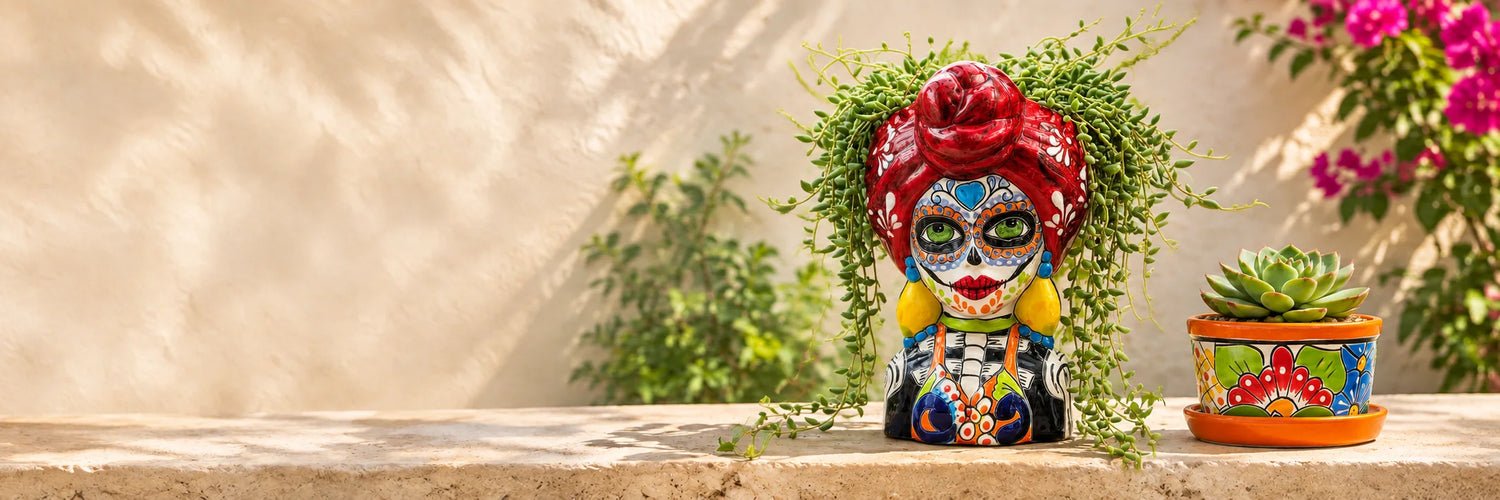
Mexico protects Talavera as a denomination of origin for modern production that meets geographic and other production requirements. The designation was first published as Talavera de Puebla in 1995 and renamed Talavera in 1997. The protected area expanded to include San Pablo del Monte, Tlaxcala, in 2003. The UNESCO inscription concerns the practice and its transmission. A museum can describe a colonial pot as Talavera based on historical evidence, while a buyer looking for protected modern production should ask for the workshop’s name and documentation. Mexico’s Talavera declaration · The 2003 amendment
Shops also use Talavera-style for ceramics with a familiar painted look. A bright planter may be handmade and have a well-documented maker of its own. The description by itself tells you little about where it was made, the process it went through, or its intended use. A label, maker’s record, and photographs of the piece give you better questions to ask. The Talavera FAQ explains what to check when comparing pieces, and the pottery care guide covers practical questions about use and cleaning.